Showing posts with label Faro. Show all posts

Thursday, December 26, 2019

Porto - Barcelona Day 11 Faro - Seville

The open court yard of The Story Guest House and goodbye for a quick stay.
We bought some light snacks for as breakfast on the our bus to Seville at Snack Bar Da Baixa at Praça Ferreira de Almeida, GPS : 37.017061, -7.933743
A short distance to the bus terminal. Photo credit : Anne Cheong.
We met an Argentine couple travelling with their touring bicycles and were on the same bus with us to Seville.
The bikes were kept at the lower compartment and secured using a long bungee cords. Next to ours were the bicycles belonging to the Argentine couple. The fare from Faro to Seville was 13Eur per pax for a distance of approximately 228 km.
We have stepped onto the soil of Spain, a toilet break at La Pausa, Chucena, Huelva, Spain at GPS : 37.347038, -6.424071. And another 65km we will be in Seville. The ladies took the chance to buy a box of Spanish olive oil biscuits.
Let's try the Spanish biscuits.
Alsa Bus ended the journey at Plaza de Armas GPS : 37.391478, -6.003204 with an old Tram on display inside the building.
Outside the building of Plaza De Armas and heading towards our accommodation which was less than a kilometere away..
We took a detour to a nearby river path, enjoying the lovely weather and beautiful surrounding.
The bridge, Puente de Isabel II as viewed from path along the river.
The Torre del Oro is also found along the river (Tower of Gold) is a dodecagonal military watchtower. It was erected by the Almohad Caliphate in order to control access to Seville via the Guadalquivir river.
Constructed in the first third of the 13th century, the tower served as a prison during the Middle Ages. Its name comes from the golden shine it projected on the river, due to its building materials (a mixture of mortar, lime and pressed hay).
Still along the river with a dedicated bicycle lane .
Taking a circular ramp up to the main road and heading towards Donkey Gallery (the name of our accommodation in Seville).
At first I thought it was some kind of a monastery building, little did I know later it is a bull fighting ring. It is the Plaza De Toros, one of the few active bullfighting rings left in Spain.
My Oregon indicated to go into the premises of the bull fighting ring as the recommended route to our desired destination.
The place we were staying at Galera Donkey located at Calle Galera GPS : 37.387558, -5.99867837. Photo credit : Anne Cheong.
A glimpse of flamenco performance in the street of Seville. We went back out to the old city to explore further including food hunting.
Suddenly we fancied a Mexican restaurant, maybe it was due to the attractive decor from the outside of the building. It's Iguanas Ranas at Calle Santo Tomás, 7, GPS : 37.384356, -5.992998
Savouring a Mexican prawn dish that was stuffed with cheese, bacon, red sauce and accompanied with rice and salad.
A typical Mexican enchilada consisting of a flour tortilla dipped in chili sauce and stuffed with meat from Iguanas Ranas.
Catedral de Sevilla (The Cathedral of Saint Mary of the See), better known as Seville Cathedral.
Christopher Columbus and his son Diego are buried in the cathedral.
Real Alcázar (Royal Alcázars of Seville) is a royal palace in Seville, built for the Christian King, Peter of Castile. It was built by Castilian Christians on the site of an Abbadid Muslim residential fortress destroyed after the Christian conquest of Seville.
Monument to the Immaculate Conception in the  Plaza del Triunfo
The Plaza de Virgen de los Reyes is a historic square, dominated by the cathedral and its unique bell tower. Horse-drawn carriages and picture-snapping tourists are part of the scenery here.
At the center of the Plaza de Virgen de los Reyes stands a monumental fountain and lamppost, created by José Lafita Diaz in 1925 for the Ibero-American exposition of 1929. The water-spouting heads are replicas of Roman grotesques found in the Casa de Pilatos.
The Giralda is the bell tower of Seville Cathedral. It was built as the minaret for the Great Mosque of Seville in al-Andalus, Moorish Spain, during the reign of the Almohad dynasty, with a Renaissance-style top added by the Catholics after the expulsion of the Muslims from the area.
The 104m tall Giralda tower was the minaret that was part of a mosque commissioned in 1171 by the second Almohad caliph Abu Ya`qub Yusuf. The mosque, which was built to replace the existing Umayyad mosque because the congregation had grown larger than the prayer hall could welcome, was completed in 1176 but construction of the minaret did not start until 1184.
Moulay Yacoub , also known as Al-Mansur, was the third Almohad caliph and in 1188 he picked up where his father had not been able to see the construction of the minaret finished. It was finally finished ten years later and looked slightly different than it does now.
In 1248 Sevilla fell in Christian hands during the Reconquista and of course the mosque was turned into a cathedral. Following an earthquake in 1356 the damaged cathedral and tower were renovated, the spheres removed and replaced by a single bell and a cross at the top of the tower.
The Giralda tower is very different from most minarets. It has ramps instead of stairs for those wanting or needing to climb it. The caliph had ordered the 35 ramps instead of endless steps so that the muezzin could ride a horse (or donkey?) to the top in order to call out the azan five times a day.
All kind of transport modes seen at Seville.
A modern tram service is also available for one to get around Seville and enjoy the gorgeous sight of the old city.
A pair of huge cube shaped trees with a fountain (Mercury Fountain) in between in front of a bank (Banco de España).
The Adriatic Building (Edificio de La Adriática) at GPS : 37.387783, -5.994367.
Built between 1914 and 1922, this striking building was designed by the architect José Espiau y Muñoz and, in the 21st century, there is no one who walks through the Avenue of the Spanish Constitution without stopping to contemplate it due to its striking beauty. Its facade has an eclectic style: it is the result of the mixture of neomudéjares, plateresque and, of course, regionalist elements, a current that was in full swing in Seville at that time. It was designed on behalf of the insurance company La Adriática and is, today, one of the most photographed corners of the center of Seville.
A metro station at Plaza Nueva where Plaza Nueva is a public square which Seville city hall is located. The land where the plaza is built was formerly part of the San Fernando convent during 1270-1840. The land was later acquired by the local government and converted into a public square. The plaza was completed in 1856.
A group of tourists on Dahon folding bicycles was seen exploring the old city, there were also other bicycle tours too moving around the vicinity.
Puncturing through the vibrant streets of Seville.
A classic shop with beautiful woodwork inside and gorgeous shop front. It is a pastry and coffee haven prominently located at GPS : 37.392653, -5.994892 at the main road of Campana.
While Anne was checking out at a Decathlon outlet we waited at a cafe ordered our beer.
Dinner was near where we stayed and the name of the shop is Casa Pepehillo GPS : 37.386729, -5.998646. The food was good and tasty such as the tapas, dogfish and
stuffed avacado and a taste of expensive Iberican ham. Drink was the red Sangria. Photo credit : Anne Cheong.
The first Spanish dinner at Seville.
Anne insisting to have her ice cream before we walk back to our apartment.

Monday, December 23, 2019

Porto - Barcelona Day 10 Lisbon - Faro

So long Lisbon we have to leave you now it would be wonderful if we were to stay for another few more days maybe a next time we will be back. At the entrance of D'Happy Inn and were ready to move on again.
We rode to Saldanha Metro Station at GPS : 38.733892, -9.144082 to catch a direct metro train to Oriente Train Station for our next destination, Faro.
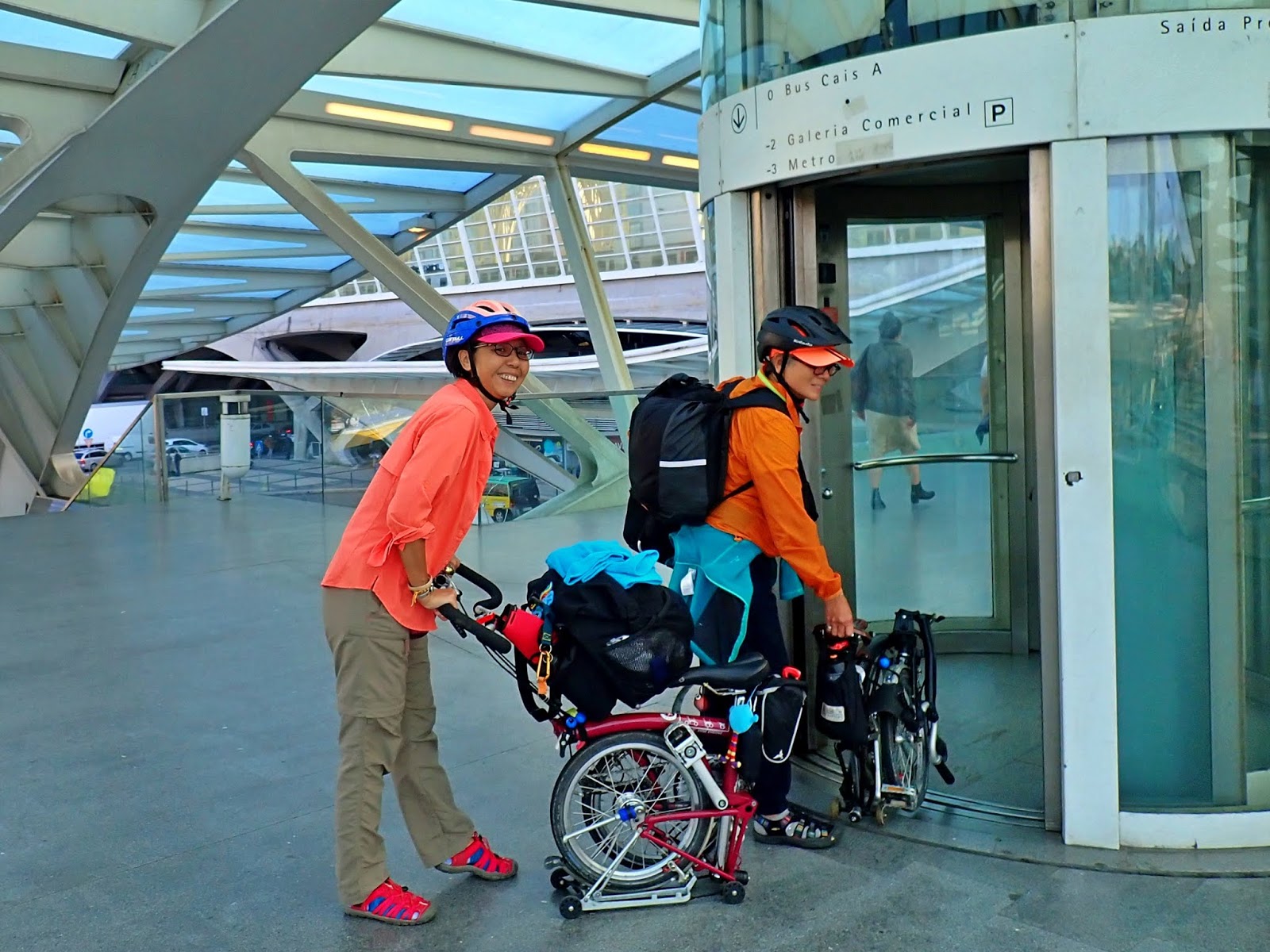
It was a rush hour, crowded with people going to work, four of us with our bikes and luggage having difficulty to gain access to the train platform. We were at one time advised by the staff to catch a later train due to the morning crowd. Bit by bit we managed to maneuver to the far end of the platform and were lucky to be able to squeeze into the arriving coach.
What a relief we made it to Oriente Train Station for the intercity train. Our fear has finally subsided. The digital directory was easily seen at the screens hung at the ceiling where we got info as to which platform to catch our train to Faro.
The hand signage was out and all into the coach, the train is moving now.....
My bungee cord came in handy again securing the bikes at a dedicated space.
Power point available for you to charge your electronic devices and by the way the fare was €11 to Faro from Lisbon.
Arrived at Faro Train Station after 3 hours of a comfortable ride. The southern most city of Portugal.
Faro is the capital of the Algarve. The old name of the city was Ossonoba, baptized by the Romans. Faro is part of Portugal since 1249, when the city and the entire region of the Algarve was conquered from the Moors by King Afonso III.
It was easy to locate The Story Guesthouse situated at R. Jose Estevao, GPS : 37.017590, -7.933954
Immediately after we have checked in for the stay at The Story Guesthouse we went out for the city ronda.
Uncle Google recommended and led us to this restaurant, Adega Nova at Francisco Barreto Street, GPS : 37.018661, -7.938363 for lunch.
Faro is situated by the sea shore, the fishes are easy available and had to be fresh & good.
Mixed seafood paella was ideal for Asians like us that was perfectly flavoured to suit our taste buds.
The fish dishes were good and delicious.
A wonderful lunch at Adega Nova, the staff was friendly and helpful. Thank you for your yummy food.
A land train to tour the centre of Faro which apparently is equipped with pre-recorded audio commentary. Might be a good idea for a quick look at Faro.
We have our bikes and did not have to use other mode of transport to see the places. Here we were riding through the shopping area of Faro.
The tall monument at the square in honour of Ferreira de Almeida who was born in the city of Faro. A great man who has contributed tremendously for Faro.
Behind the Porta Arabe which is the entrance to the Muslim city of Santa Maria and often referred to as the Arab Gate. It was served as access for those who came by sea and had a drawbridge over the marshland linking to mainland.
There is a legend associating the existence of an image of the Virgin on the walls that the Arabs laid into to the sea that resulted the land and sea ceasing to produce. The Arabs then returned the image to its original place which eventually caused the land bear fruit and the sea fish were found to be in abundance.
The medieval Cathedral of Faro. Church was built on the ruins of the ancient Roman temple, it was also a mosque during the Arab period then being adapted to a Church after the conquest of D. Afonso III. Located at GPS : 37.013303, -7.934959
Monument to Bishop Francisco Gomes de Avelar at GPS : 37.013603, -7.935283.
Dom Francisco Gomes de Avelar is said to had devoted his life in the improvement of Faro, investing in public building and improvement of urban infra-structures. He lived between 1736 and 1816, dying of old age with a long life for his time (80 years).
The statue of King D. Afonso III, standing in Faro’s historic walled city, found in front of the Municipal Museum.
The old town of Faro has many long narrow roads some with interesting ceramic wall tiles like this one. Photo credit : Jocelyn.
The sun was setting at the waterfront and we were having fun with our cameras.


Anne & F.A.R.O.
Faro with the 3 ladies and our Brompton.
The marina of Faro. It would be lovely to spend some time admiring the flashy yachts at the marina at one of the cafes.
There is also Faro's Maritime Museum which is found in the vicinity of the waterfront although it's quite small but it has some interesting displays relating to Portugal’s Age of Discovery, including a model of one of the boats in which Vasco da Gama sailed around the Cape of Good Hope to India in 1498.
Europe is generally bicycle friendly but we don't need this we have our own bicycles.
The reception of The Story Guest House recommended us to checkout this Restaurante À do Pinto at Tv. Rebelo da Silva GPS : 37.015912, -7.932836
A simple decor restaurant yet cozy.
Overall the food was excellent, always love the Portuguese which I am starting to like it. The seafood was fresh and delicious, what not all from the shore of Faro itself. Photo credit : Anne Cheong.
Paella with delicious succulent & fresh prawns.
Some kind of mixed seafood dish like what we get in Malaysia which we call "Pun Choy", ths was also another fabulous mouth watering dish.
Cheers and that was our last night in Portugal, it had been a wonderful journey in Portugal and I would love to come back again for the gorgeous scenery and most importantly the Portuguese food.