|
| Good morning Seville - I was taking a look at the weather outside the apartment and it was pretty cloudy with slight mist. We have arranged for a city walking tour later in the morning meanwhile we were gamed for a short ride. |
 |
| My bike has been set up and ready to roll just waiting next to a Gespa and a locked Dahon Speed P8 at another block nearby. |
 |
| The 6 of us who came out this morning for a ride were posing in front of the bull fighting ring at Plaza de Toros de la Real Maestranza de Caballería de Sevilla. |
 |
| Went over to the pedestrian lane along the river and had a view at bridge Puente San Telmo. |
It was a short ride in deed to just our itch to pedal before going for our walking tour, Kevin passing by Torre del Oro.
 |
| A stroll to the the old city for the walking tour. |
 |
| The meeting point for Seville Free Walking Tour was at the statue of King Fernando III (King of Castilla and León) located at Plaza Nueva, GPS : 37.388606, -5.995604 |
 |
| City Hall of Seville - Visitors to Seville will notice a symbol on many signs around the city, from taxis and buses to sewer covers, consisting of the letters ´NO8DO´. This is the city´s logo, and legend says that it originates from the 13th-century coat of arms awarded to Sevilla by King Alfonso X the Wise. He bestowed it in gratitude for Seville´s support in his battles against his son, Sancho IV of Castile, who wanted to usurp his father´s throne during the Reconquest. Between the ´NO and ´DO´ is an 8-shaped bundle of wool (madeja in Spanish). Add the three together, speaking in Seville´s fast, elliptical accent and you have ´no-madeja-do´, more correctly, ´no me ha dejado´ which means ´it (the city) has not abandoned me´. The motto was his reward to the people of Seville for their loyalty. |
 |
Iglesia Colegial del Salvador, the second largest church in Seville, after the Seville Cathedral.
This baroque church was built between 1674 and 1712 on the site of Muslim Ishbiliya's main mosque. The tiered red-brick facade is actually Mannerist in style, while the interior reveals a rich display of carving and gilding. |
 |
| Entrance to the Alcazar |
 |
| Patio de Banderas - During the Muslim era of the city, while they lived in the fortress, Abderramán III ordered this space to be built as a palace during the 10th century. It came to be known as the Dar Al-Imara or Prince’s house, or the house of the Governor which was accessed by another door. |
 |
| Within the surrounding of Plaza de Doña Elvira GPS : 37.384833, -5.990486 |
 |
| Grocery store giving free food sample to try so were the pigeons enjoying themselves with the goodies. GPS : 37.384716, -5.990563 |
 |
| The building that houses the museum was originally a house in the central Seville neighborhood of Santa Cruz , built in 1918, which was acquired in 1973 by the Granada-born painter Amalio García del Moral to establish his studio there. The choice of this particular building was due to the views of the Giralda that it owns, which were of great relevance to the artist, since most of his work revolved around the mentioned monument. |
 |
| Listening to more stories - In 1480 the newly-emerging kingdom of Spain sought to strengthen itself through enforced conformity to Catholicism, many Jews had already left or converted to Christianity, but suspicion among some Christians that these conversos were not true converts, and hoped to bring about a restoration Judaism, had recently led to the creation of the Spanish Inquisition, charged with rooting out heresy and religious dissent wherever it was to be found. Don Diego de Susona, a wealthy merchant, was one such converso, and alarmed by the threat to his position, he convened a secret meeting of prominent conversos to discuss the possibility of armed insurrection. |
 |
Susana Ben Susón, nicknamed La Susona and the skull of Susona in the door where her old home was. Photo credit : Anne Cheong.
Susona daughter of Don Diego de Susona, however, had a Christian boyfriend, a young noble, who she feared would be put in danger by an uprising, and she revealed the plot to him. Her boyfriend promptly reported them to the authorities, and the conspirators were duly arrested and brought before the Inquisition, tried and executed.
Stricken with remorse at the consequences of her action, Susona never again left her house, and when she died she had her head hung up outside the house (where it remained as late as the 18th century) as a testament to her grief and the duplicity of Christians. |
 |
| GPS : 37.384830, -5.988709 Jardines De Murillos entering Calle Antonio el Balarin |
 |
| Walking along Calle Antonio el Balarin. |
 |
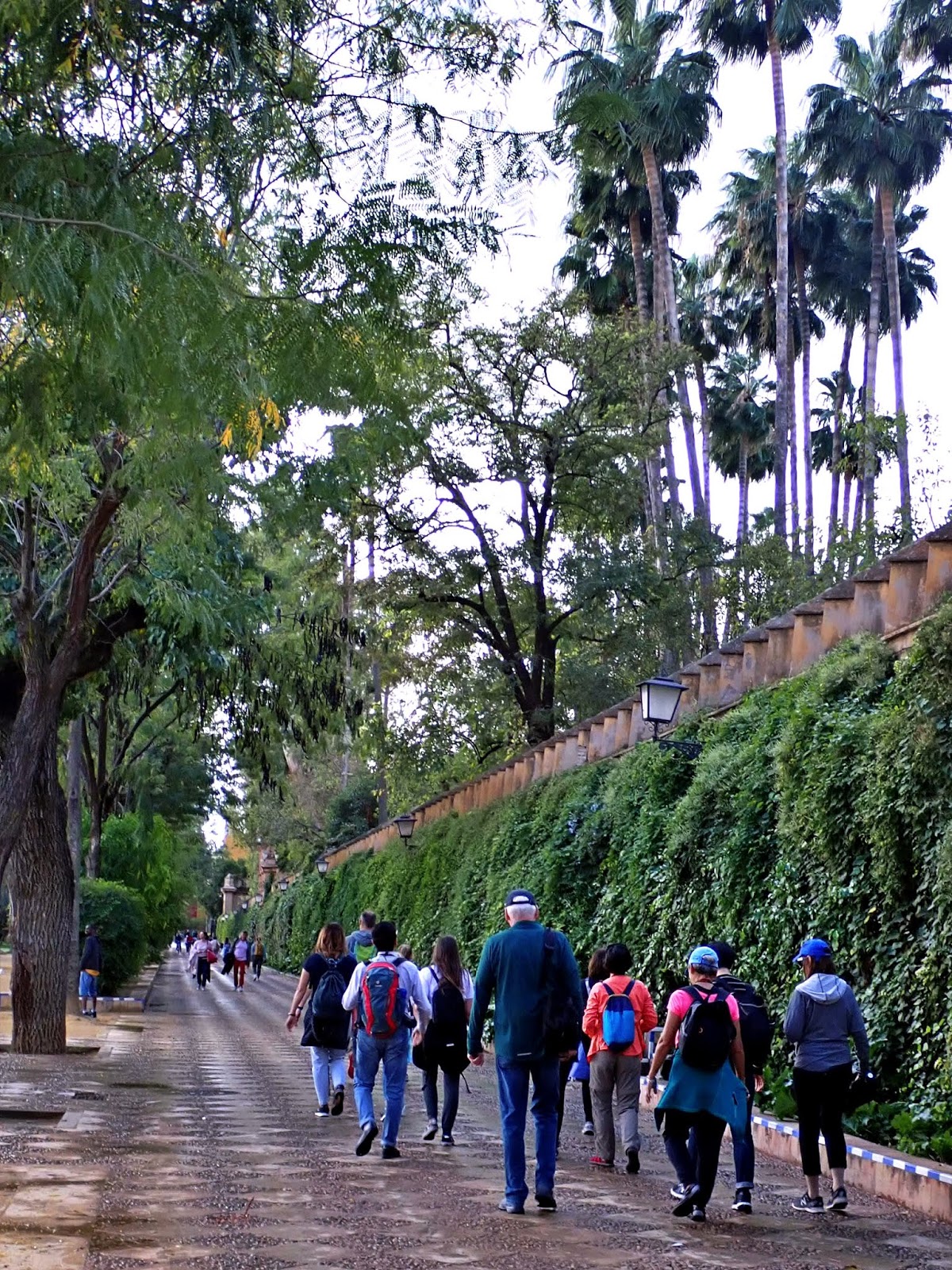
| I guess this is at the fringe of the Royal Alcázar of Seville at Paseo de Catalina de Ribera GPS : 37.382818, -5.988582 |
 |
| The Royal Tobacco Factory is an 18th-century stone building in Seville. Since the 1950s it has been the seat of the rectorate of the University of Seville. Prior to that, it was a tobacco factory: the most prominent such institution in Europe, and a lineal descendant of Europe's first tobacco factory, which was located nearby. It is one of the most notable and splendid examples of industrial architecture from the era of Spain's Antiguo Régimen. GPS : 37.381628, -5.990955 |
 |
| Thank you so much for an interesting walking tour where we get to listen the history and stories of beautiful Seville. Photo credit : Anne Cheong. |
 |
| Hotel Alfonso XIII -One of Spain's most prestigious hotels in Seville - A luxury hotel located next to the Royal Alcázar of Seville. |
 |
| The flamenco dancer in action, one after another waiting for their turn to performance and earn some money. |
 |
| Fenn was filling up her tumbler from the drinking water tap at the road side. |
 |
| Horse carriages commonly seen and making distinguish noise as they rolled over the cobblestone. |
 |
| The Andalusian Parliament of Seville where politicians debate over issues before implementing new rules. |
 |
| Me & Joe went out to get our laundry done at one outlet near our apartment. |
 |
| A night where we went two places to eat when tummies were not fully filled at the first restaurant. |
 |
| The first tapas restaurant. |
 |
| The second restaurant, the waiter looked like Richard Gere. And finally we were done with our dinner for the 12th day. Good night Seville. |