Showing posts with label Granada. Show all posts

Saturday, February 01, 2020

Porto Barcelona Day 18 - One More Day in Granada

Day 18 where 5 of the group will be leaving to Barcelona via a local flight while the remaining 3 will take a slower pace of visiting towards Barcelona.
Goodbye till we see each other again. The taxis were ready to leave for the airport.
Meanwhile, we were on a free and easy mode in Granada and took a morning stroll to some places where we did cover but saw glimpses while on the mini bus a day before.
After walking through a quiet forest trail we stumbled into Alhambra Palace Hotel GPS : 37.185427, -3.606915
Puerta de las Granadas - The Gate of the Pomegranates is an historical access point of a pathway that leads through the Forest of the Alhambra to the Nasrid palace that is the Alhambra, located in the city of Granada, Spain. The path starts in the city centre, Plaza Nueva, and continues up the Cuesta de Gomérez, before reaching the monument. GPS : 37.176059, -3.593100
After the gate we continued walking along Cuesta de Gomérez street with shops selling souvenirs, garments and cafe.


One of the several narrow alleys along Cuesta de Gomérez street
High Court of Justice of Andalusia is the highest court of Andalusia for the Spanish exclaves of Ceuta and Melilla. GPS : 37.177151, -3.595649
Church of San Gil y Santa Ana which is situated opposite the Royal Chancellery, this church was built during the second third of the 16th century on the site of an old mosque. It is in Mudejar style, with a single nave and side chapels. GPS : 37.177374, -3.594998
Pilar del Toro, a water cooler within the same neighbourhood with interesting water nozzles. 
The narrow road of Carrera del Darro with a small stream flowing parallel that I like it very muchg. There were ducks swimming in the stream and it was a lovely walk in deed. GPS : 37.178019, -3.593724
Alcaiceria, home of the Great Bazaar of Granada, was originally a series of streets between Plaza Nueva and Plaza Bib-Rambla, bursting with stalls selling Arabic silks, spices and other precious goods. Nowadays the only remaining section is Calle Alcaiceria, beginning just off the Calle Reyes Catolicos, and extending back as far as the Cathedral. It is an area rich with history and local culture, still packed with interesting, exotic things to buy. GPS : 37.175202, -3.598447
Later we went back to the apartment to get our bicycles to recce our route to the bus terminal. It was back the same Fuente de las Batallas but this time it was nice to see it with the water in the fountain.
Similiarly at Fuente de las Granadas there was water this time. Two days ago when we came there wasn't any, located at GPS : 37.169352, -3.595767
Taking the metro train will be part of the plan for the evening route to the bus terminal.
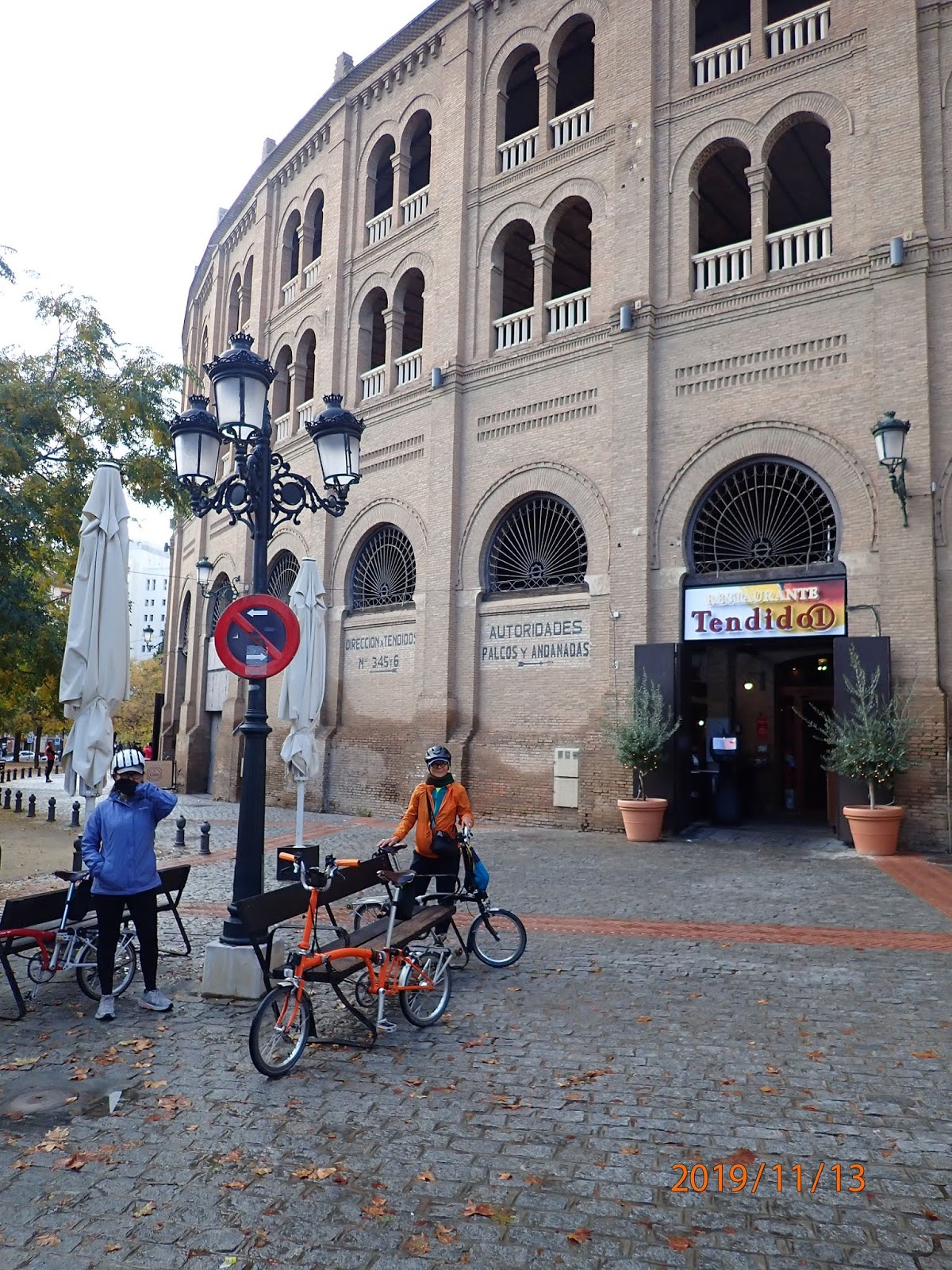
Plaza De Toros De Granada located at Calle Dr. Oloriz, GPS :  37.188756, -3.606963
Also known as “Monumental de Frascuelo” , is a historic building in the city of Granada, where bullfights and other public shows are held. The building was built between 1927 and 1928.
Plaza de Toros de Granada is one of the ten largest bullrings of Spain, with a circle of 50.40 meters in diameter and has 12,000 seats.
The sculpture of a bullfighter named Salvador Sánchez, also known as Frascuelo has been a controversial statue in Granada for certain reasons which was left to be ascertained. This sculpture was created Ramiro Megías. Located at Boulevard of the Constitution Avenue GPS : 37.186071, -3.608192
 This sculpture of a queen holding a crown, wondering what is the story behind it.
Seated and admiring the statue of a flamenco dancer located at La Canastera GPS : 37.185427, -3.606915 along the same avenue.
Finally we made our way to Recogidas Metro Station and were ready to move on and continue our journey.
The metro ticket of Granada.
The metro train stopped just next to the Granada Bus Terminal located at GPS : 37.200035, -3.613408
Our coach to Valencia departing at 11.30pm from Granada Bus Terminal and expecting to arrive at 7am and covering a distance of 500km. The fare was 41.50 euro including 10 euro for the bike per person. See you Valencia soon.

Thursday, January 30, 2020

Porto Barcelona Day 17 - A Day at Alhambra Granada

Good morning and hello Alhambra, we were making our way through streets and steep alleys looking for you.
Plaza Isabel La Catolica is a common place where most will pass by it many times whenever you are in the neigbourhood. It is a square with a bronze monument of the Queen Isabel I of Castille. GPS : 37.175667, -3.597387
Somewhere along Gran Vía de Colón Street we made enquiry as how to get around in Granada. First we decided to visit a view point at Plaza St. Nicolas before spending the whole day at Alhambra.
We took an Alhambra mini bus numbered C32 to Plaza St. Nicolas, known for its viewing platform.
Mirador San Nicolas located at GPS : 37.181114, -3.592670, the sun was coming against us, a prefect view of Alhambra would be in the evening when the sun is setting. Anyway there were still many people gathering at the viewing platform and taking pictures.
We then jumped back into the Alhambra mini bus for the next stop at Alhambra using the same tickets without any further fee as long as the ticket is being used within the allowable time frame. By the way the bus ticket price was 1.4 euro per head.
Finally we reached Alhambra at the main entrance. Jo have has purchased the tickets online prior to our visit. It was the Alhambra General Daytime ticket amounting 14.85€ per head.
The place is huge and we decided to take on Generalife Gardens first. Generalife occupied the slopes of the Hill of the Sun (Cerro del Sol), from which there is a complete view over the city and the valleys of the rivers Genil and Darro. The Generalife became a leisure place for the kings of Granada when they wanted to get away from their official affairs of the palace.
It was built in the 13th century and it was redecorated by the King Abu I-Walid Isma'il (1313-1324). Generalife is basically divided by two groups of buildings connected by the Patio of the Irrigation Ditch (Patio de la Acequia). 
It is difficult to know what exactly Generalife looks like when it was in its original condition, as it has went through many alteration and re-construction throughout the Christian period. These changes were necessary due to its dilapidated state left neglected during the Muslim period.
The view from Generalife towards Alhambra and its community at the lower ground. 
Covering the gardens and trying not to miss out any of the interesting elements of Generalife.
The Garden of the Irrigation is one of the main features connecting the 2 group of buildings.
Nasrid Palace and Alcazaba as seen from Palacio del Generalife, Alhambra
Time to re-fuel and rest the leg before proceeding to the next spot. Obviously we were prepared as far as food and drink are concerned in the park.
A chance to observe how these big hedges of plant were being manicured.
A ruin where we passed by while moving towards the Palace of Charles V, a potential site to be improved and make it exciting for tourists.
The Palace of Charles V is a Renaissance building inside the Nasrid fortification of the Alhambra. The building has never been a home to a monarch and stood roofless until 1957. The exterior of the building uses a typically Renaissance combination of rustication on the lower level and ashlar on the upper.
I thought it was a bull fighting ring the moment I came into the building as the has an inner circular patio. No it was no a bull fighting ring but a two storey palace.
Another image captured of the circular patio. The palace that was not completed initially and remained roofless until the late twentieth century.
We took another break at the Square of the Cisterns (Plaza de los Aljibes) which was built by Count of Tendilla in 1494 in the gully between the Alcazaba and the palaces. Another beautiful view from the square where there is a kiosk selling coffee, snacks and ice cream. 
 A panoramic view of the city from the square. An esplanade between the towers and the defence of the Alhambra on one side and the Wine Gate (Puerta del Vino), the Arabic palaces and the Charles V Palace (Palacio de Carlos V) on the other side.
Alcazaba was next on our visit list for the day.
Alcazaba is a fortress and one of the oldest parts of Alhambra just like the Vermilion Towers (Torres Bermejas). It is believed that it was built before the Muslims arrived at Granada where there were already several constructions in the same area. 
The first historical reference to the existence of the Alcazaba dated back from the 9th century and it is believed that it was then built by Sawwar ben Hamdun during the fights between Muslims and muwalladins (Christians who converted to the Islam and lived among the Muslims). 
The current complex was built by Mohammed I, who constructed the ramparts around the previous castle, defence and three new towers: The Broken Tower (Torre Quebrada), the Keep (Torre del Homenaje) and the Watch Tower (Torre de la Vela). As a consequence, the Alcazaba became a real fortress, where the king established the royal residence. His son Mohammed II also had his residence in the Alcazaba, until the palaces were finished. From then on, the Alcazaba was only used as a fortress for military purposes. 
When the Christians took the city, they carried out many works to repair the Alcazaba. At certain part of the history it was used as a State prison, even during the French occupation. 
Like the Alhambra, the Alcazaba was abandoned and not cared for a long time and it was not until the late 19th century and beginning of the 20th century that the restoration began.
Our last place to visit with a scheduled time to enter the Palace of Nazri. We had to queued for the entrance and security was observed when entering.
The Palaces were the residence of the kings of Granada. Alhambar, the founder of the dynasty began to build in the 13th century. These palaces enclose within their walls the refinement and delicacy of the last Hispanic-Arab governors of Al Andalus and the Nasrid.
The intimate concept of the royal palace, closed in the eyes of the curious, harmonizes the robustness of the outer panels with the fragility of the interior, where the architectural elements become purely ornamental. 
One of the amazing pieces of the Alhambra, a brilliant Islamic building in Europe, with perfectly proportioned rooms and courtyards, intricately moulded stucco walls, beautiful tiling, fine carved wooden ceilings and elaborate stalactite-like muqarnas vaulting, all worked in mesmerising, symbolic, geometrical patterns. Arabic inscriptions proliferate in the stucco work.
The courtyards, continuous allusions to the garden, with elements of Persian and Muslim inspiration. 
A peep into the court yard as we were flowing through with the stream of tourists in the palaces.
The water, element that forms the palace, combining the garden with the architecture, represents the purity; Crystalline water that flows between the marbles of the fountains; Water of life that gives richness and freshness to the garden, aesthetic beauty, generosity of the Sultan ... a whole world of symbols and stimuli.
That's was it we finally visited Alhambra and had a good knowledge of the Muslim influence in this part of Europe.