Monday, February 03, 2020

Porto Barcelona Day 19 - Hello Valencia

The bus arrived at Valencia Bus Station (Estació d'autobusos de València) on the dot located at Carrer de Menéndez Pidal, GPS : 39.480278, -0.387586
There were only a handful of travellers at the station in the early morning and we had coffee from the cafeteria with a flock of pigeons salvaging food that was left on the tables.
At the outside of Valencia Bus Station and were ready to ride on the streets and locate our lodging. Our direction was kind of towards south east. The weather was cold but bearable.
València is a bike-friendly city that is perfect to pedal around. It is easily accessible, flat and surrounded with many historical places.
A garden that cuts through the urban heart of the city that you can bike without any rush, whilst enjoying the lovely climate.
The city belongs to the Network of Cycling Cities, has over 156 kilometres of cycle paths and is home to the old course of the Turia River.
Still on the bicycle lane as we were approaching our destination after covering a distance of 7km.
That was it our accommodation in Valencia and will be staying for the next few days at Flats for You. GPS : 39.462640, -0.334313 along Carrer d'Ernest Anastasio.
A decent apartment with two rooms with basic facilities that would be ideal for a short stay.
A simple and clean bedroom.
A short walk to a cafeteria called La Cocineria Bistro for lunch before we start our sight seeing.
The neighbourhood where we were staying is quiet with couple of old buildings being refurbished for new occupancy.
Within less than 3km from our apartment we reached the amazing futuristic park.
Valencia's Science Museum sits at the heart of the City of Arts and Sciences - Valencia's 2 km long cultural centre. It spans four floors and offers both temporary and permanent exhibitions. It is a place to bring the whole family as there is the opportunity for the kids to play and for the grown-ups to learn some interesting facts. The building itself is also worth a visit - it is surrounded by 13,500 square metres of water a has a unique futuristic shape.
Queen Sofía Palace of the Arts is the final structure built of a grand City of Arts and Sciences concept designed by the Valencia-born and internationally known architect Santiago Calatrava, which began in 1995. The building was constructed by a joint venture of Dragados and Necso and it was opened on 8 October 2005.
L'Hemisfèric (1998) — an IMAX Cinema, planetarium and laserium. The building is meant to resemble a giant eye, and has an approximate surface of 13,000 m². The Hemesfèric, also known as the planetarium or the "eye of knowledge", is the centerpiece of the City of Arts and Sciences. It was the first building completed in 1998. Its design resembles an eyelid that opens to access the surrounding water pool. The bottom of the pool is glass, creating the illusion of the eye as a whole. This planetarium is a half-sphere composed of concrete 110 meters long and 55.5 meters wide.
 The shutter is built of elongated aluminum awnings that fold upward collectively to form a brise soleil roof that opens along the curved axis of the eye. It opens to reveal the dome, the "iris" of the eye, which is the Ominax theater. The City of Arts and Sciences is divided in half by a set of stairs that descend into the vaulted concrete lobby. The underground spaces are illuminated with the use of translucent glass panels within the walking path. The transparent roof is supported by concrete arches that connect to the sunken gallery. There is a remarkable echo in the building and if two people stand at the two opposite pillars inside of the eye they can speak with each other.
The City of Arts and Sciences is situated at the end of the former riverbed of the river Turia, which was drained and rerouted after a catastrophic flood in 1957. 
The old riverbed was turned into a picturesque sunken park.
The City of Arts and Sciences is a cultural and architectural complex in the city of Valencia. It is the most important modern tourist destination in the city of Valencia and one of the 12 Treasures of Spain.
This museum belongs to the City of Arts and Sciences complex. The building was designed by Santiago Calatrava and reminds a whale skeleton. 
This is one of those museums where forbidden NOT to touch. It is orientated to learning the sciences through experience, so everything is graphically displayed, with huge texts and pics, experiments, buttons to touch and experience... perfect to go with kids of 7-12 years!
Bumped into a bicycle shop that sells Brompton bicycles but it was closed and having an unique siesta time (2pm to 5pm).
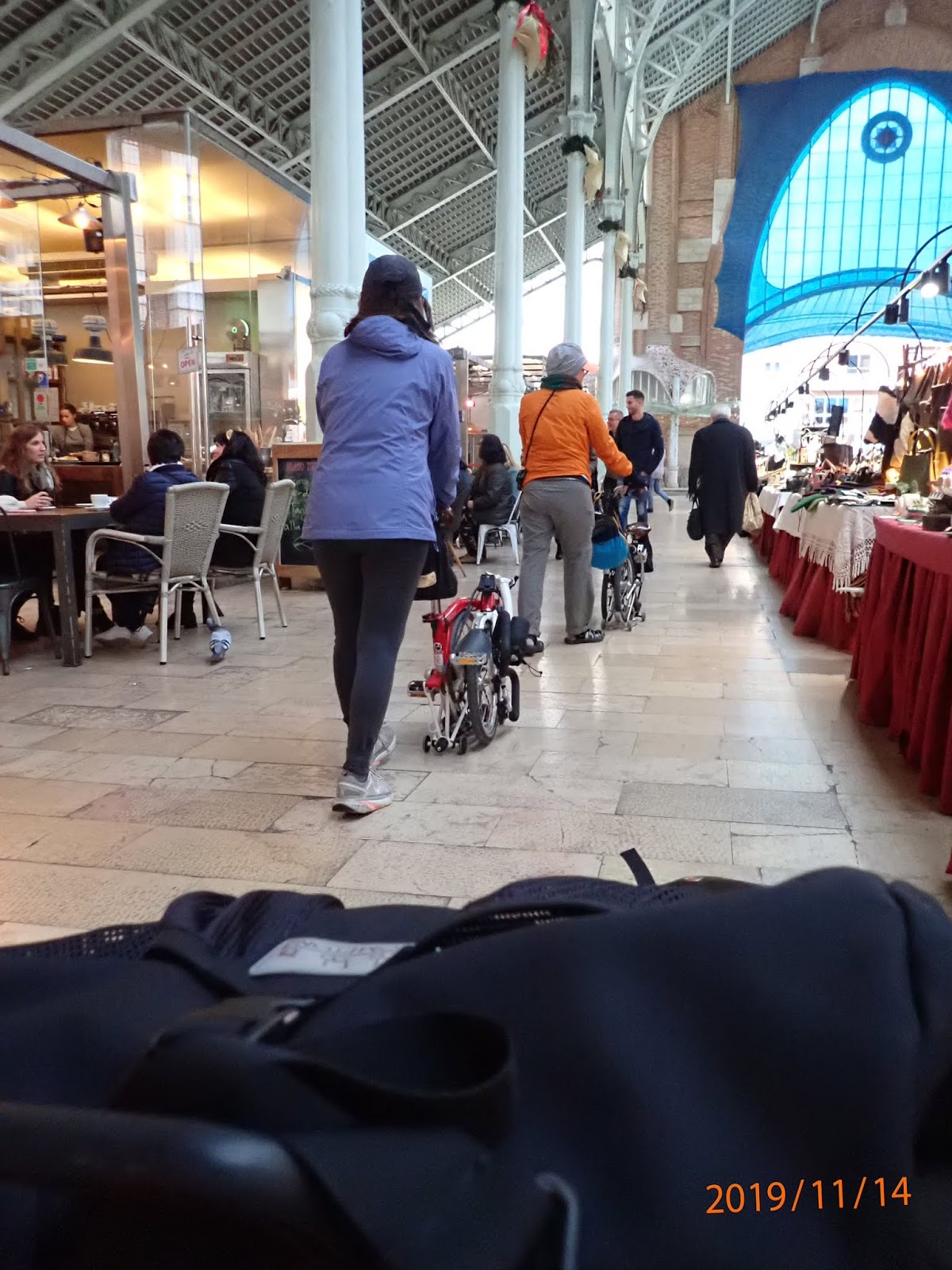
Colon Market ( Mercat de Colon) located at Carrer del Comte de Salvatierra, GPS : 39.469175, -0.367847
One of the most emblematic modernist buildings in the city. It was built in 1914 by Francisco de Mora y Berenguer.
 It is an open, circular area occupying the whole block and brings to mind the old awnings of the traditional market places. 
An important restoration project, working on the structure, brickwork, ceramic work and wood has returned the market to its former glory; the trencadís that decorates the original entrance is of special interest. The market is a city meeting point with its colourful, Valencian façade reminiscent of the modernist designs of Gaudí.
We settled down with a beer cum coffee break at this beautiful market.
Puente de la Peineta – the white comb like work by Santiago Calatrava– spanning the riverbed between the ancient ashlars of the Puente del Real and the colourful splendour of the Puente de las Flores bridges. The bridge is built in high-tensile steel and is set on one single span, with a 14-metre high arch running from one end to the other. Alameda underground station is below. GPS : 39.473045, -0.366358
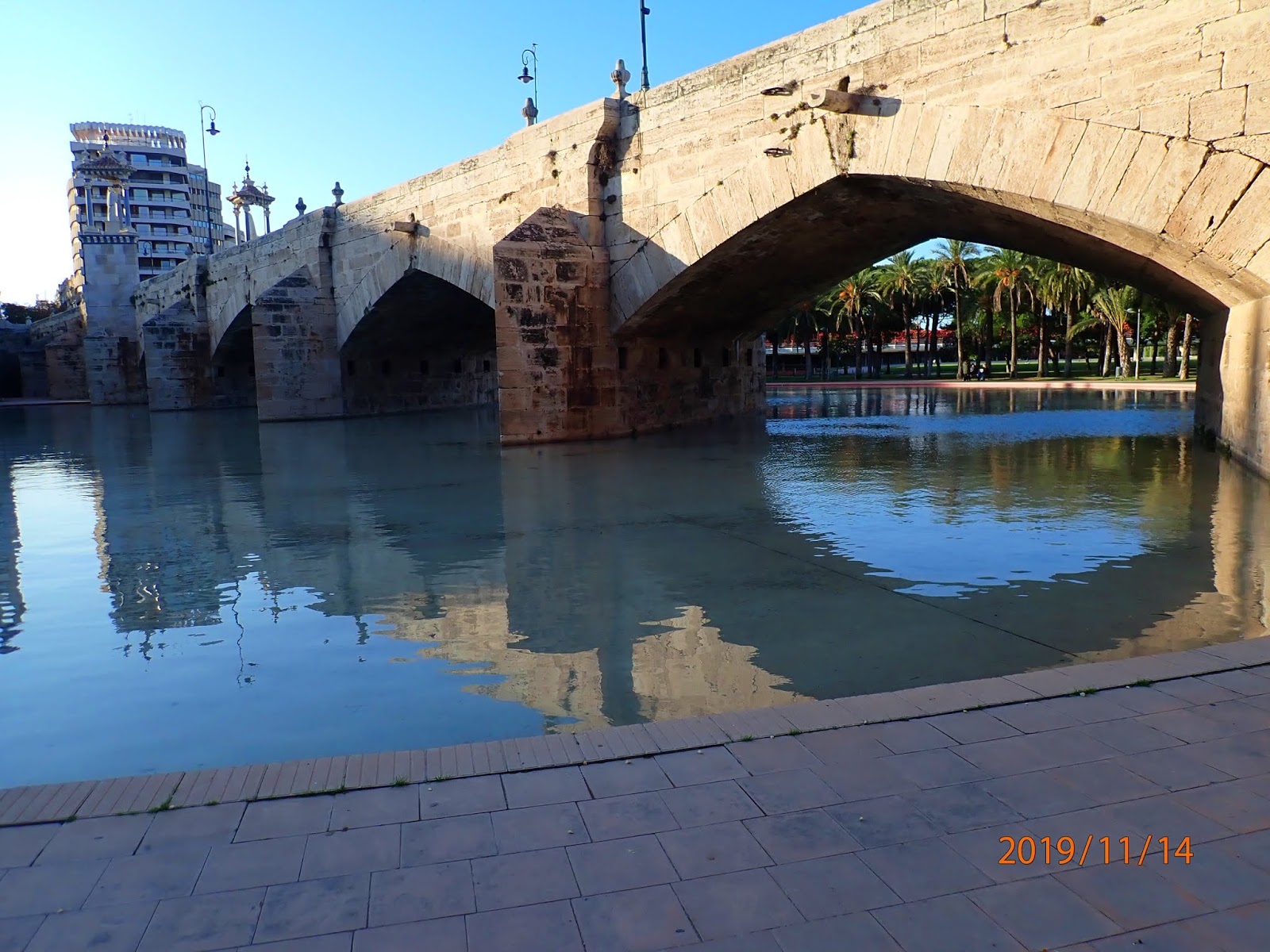
The Puente de la Mar is framed between Calatrava's construction and the Puente de Aragon and surrounded by palm trees. It was rebuilt after flooding in 1591 that destroyed the simple wooden bridge that stood in its place, and for centuries was the natural route connecting the city with the port. In 1933, the Puente de la Mar was closed to traffic thanks to a project by the architect Javier Goerlich, who also built the magnificent access stairways well into the 20th century. GPS : 39.470246, -0.364180
The Turia Gardens or Jardines del Turia, lie in a former riverbed which snakes through Valencia city centre like a long green ribbon, stretching all the way from the Bioparc to the City of Arts and Sciences and on towards the sea.
The building opposite the road is Museu de Belles Arts de València along Carrer de Sant Pius V, GPS : 39.478928, -0.371280
Torres de Serranos located at Carrer del Comte de Trénor GPS : 39.479413, -0.375905 also known as Serrans Towers or Serranos Towers is one of the twelve gates that formed part of the ancient city wall, the Christian Wall of the city. It was built in Valencian Gothic style at the end of the 14th century (between 1392 and 1398).
It is an important landmark and one of the best preserved monuments of Valencia.
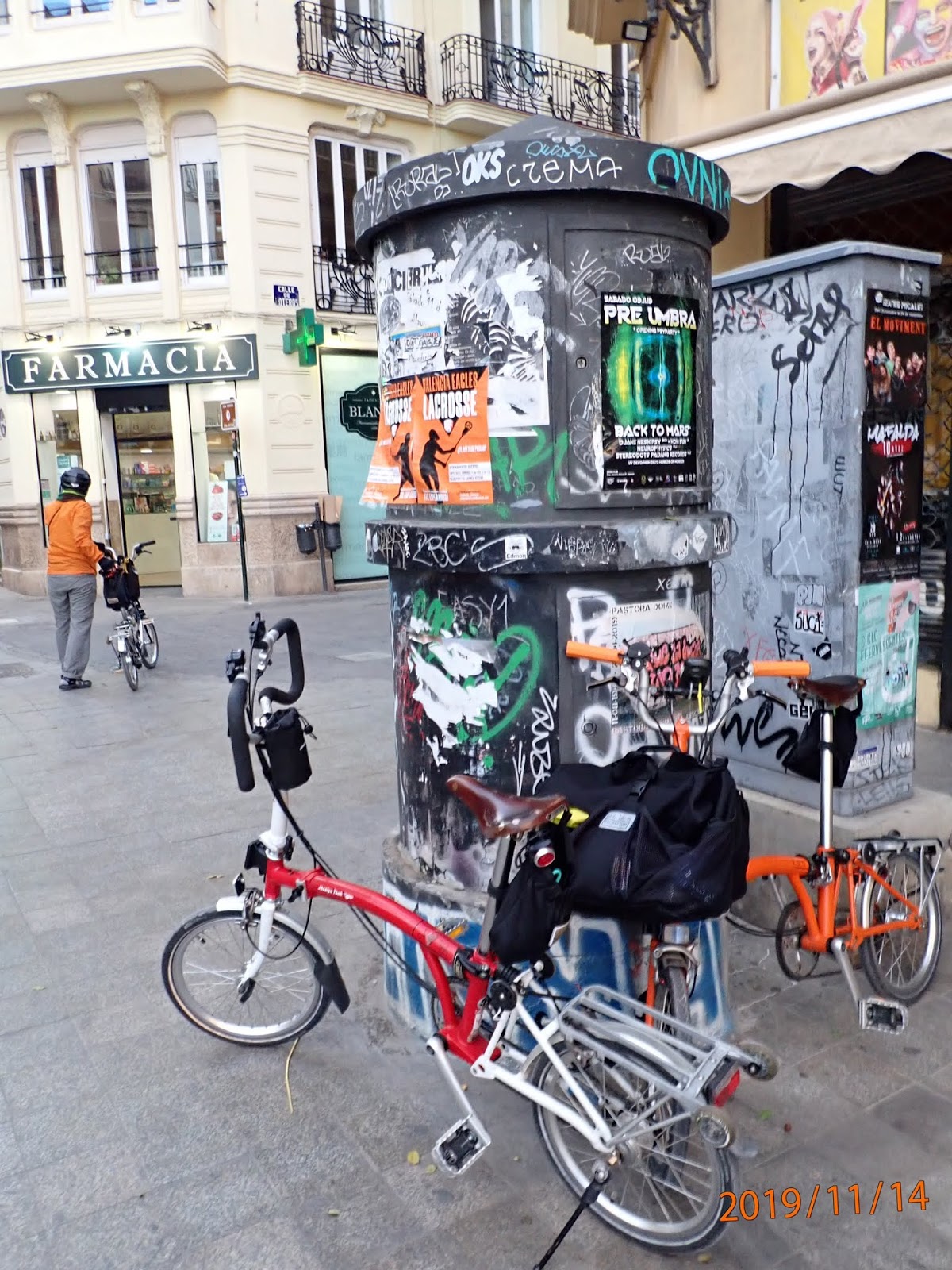
We mingled around the walled city with narrow alley and paths.
Fuente del Turia (Turia Fountain) in the vicinity of the cathedral of Valencia GPS : 39.476438, -0.375334. This lovely square represents the Turia River and depicts Neptune. At one end, you’ll find doors leading to the Cathedral, known as the Apostle Doors with the carvings of the 12 apostles adorning the entry.  
It was getting dark when we saw this market, we shall visit it tomorrow, that's the Central Market of Valencia.

Saturday, February 01, 2020

Porto Barcelona Day 18 - One More Day in Granada

Day 18 where 5 of the group will be leaving to Barcelona via a local flight while the remaining 3 will take a slower pace of visiting towards Barcelona.
Goodbye till we see each other again. The taxis were ready to leave for the airport.
Meanwhile, we were on a free and easy mode in Granada and took a morning stroll to some places where we did cover but saw glimpses while on the mini bus a day before.
After walking through a quiet forest trail we stumbled into Alhambra Palace Hotel GPS : 37.185427, -3.606915
Puerta de las Granadas - The Gate of the Pomegranates is an historical access point of a pathway that leads through the Forest of the Alhambra to the Nasrid palace that is the Alhambra, located in the city of Granada, Spain. The path starts in the city centre, Plaza Nueva, and continues up the Cuesta de Gomérez, before reaching the monument. GPS : 37.176059, -3.593100
After the gate we continued walking along Cuesta de Gomérez street with shops selling souvenirs, garments and cafe.


One of the several narrow alleys along Cuesta de Gomérez street
High Court of Justice of Andalusia is the highest court of Andalusia for the Spanish exclaves of Ceuta and Melilla. GPS : 37.177151, -3.595649
Church of San Gil y Santa Ana which is situated opposite the Royal Chancellery, this church was built during the second third of the 16th century on the site of an old mosque. It is in Mudejar style, with a single nave and side chapels. GPS : 37.177374, -3.594998
Pilar del Toro, a water cooler within the same neighbourhood with interesting water nozzles. 
The narrow road of Carrera del Darro with a small stream flowing parallel that I like it very muchg. There were ducks swimming in the stream and it was a lovely walk in deed. GPS : 37.178019, -3.593724
Alcaiceria, home of the Great Bazaar of Granada, was originally a series of streets between Plaza Nueva and Plaza Bib-Rambla, bursting with stalls selling Arabic silks, spices and other precious goods. Nowadays the only remaining section is Calle Alcaiceria, beginning just off the Calle Reyes Catolicos, and extending back as far as the Cathedral. It is an area rich with history and local culture, still packed with interesting, exotic things to buy. GPS : 37.175202, -3.598447
Later we went back to the apartment to get our bicycles to recce our route to the bus terminal. It was back the same Fuente de las Batallas but this time it was nice to see it with the water in the fountain.
Similiarly at Fuente de las Granadas there was water this time. Two days ago when we came there wasn't any, located at GPS : 37.169352, -3.595767
Taking the metro train will be part of the plan for the evening route to the bus terminal.
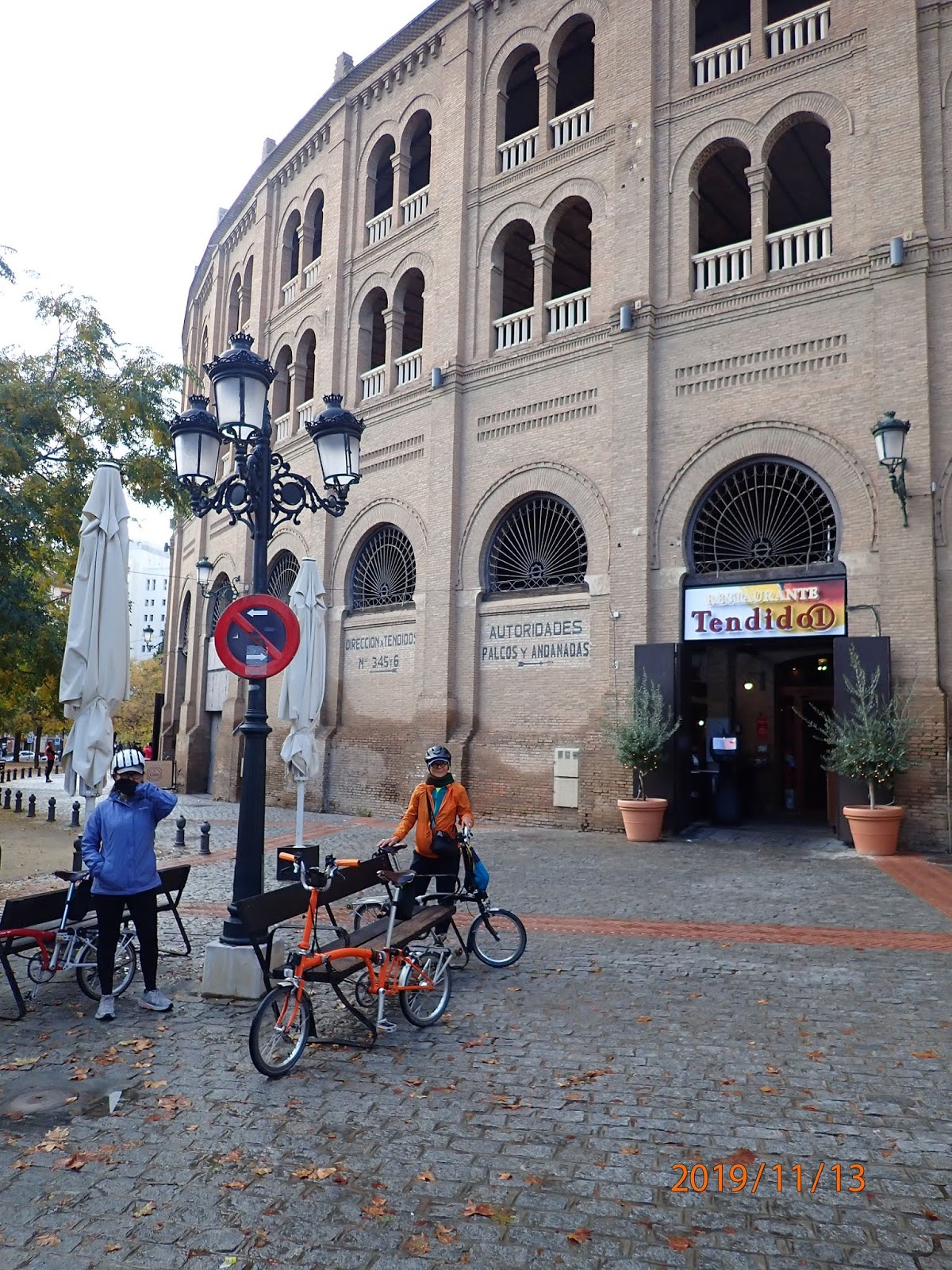
Plaza De Toros De Granada located at Calle Dr. Oloriz, GPS :  37.188756, -3.606963
Also known as “Monumental de Frascuelo” , is a historic building in the city of Granada, where bullfights and other public shows are held. The building was built between 1927 and 1928.
Plaza de Toros de Granada is one of the ten largest bullrings of Spain, with a circle of 50.40 meters in diameter and has 12,000 seats.
The sculpture of a bullfighter named Salvador Sánchez, also known as Frascuelo has been a controversial statue in Granada for certain reasons which was left to be ascertained. This sculpture was created Ramiro Megías. Located at Boulevard of the Constitution Avenue GPS : 37.186071, -3.608192
 This sculpture of a queen holding a crown, wondering what is the story behind it.
Seated and admiring the statue of a flamenco dancer located at La Canastera GPS : 37.185427, -3.606915 along the same avenue.
Finally we made our way to Recogidas Metro Station and were ready to move on and continue our journey.
The metro ticket of Granada.
The metro train stopped just next to the Granada Bus Terminal located at GPS : 37.200035, -3.613408
Our coach to Valencia departing at 11.30pm from Granada Bus Terminal and expecting to arrive at 7am and covering a distance of 500km. The fare was 41.50 euro including 10 euro for the bike per person. See you Valencia soon.