Monday, January 26, 2015

Turkey - Cappadocia Day 5

We checked into Burcu Kaya cave hotel late in the night and was tired to explore the place. A good rest was what we waited before we enter into the world of Cappadocia, a name that was traditionally used in Christian sources throughout the history and is still widely used as an international tourism concept to define a region of exceptional natural wonders, like the fairy chimneys and a unique historical and cultural heritage of this region.
Just outside our room it has a good view and it is so scenic and interesting.
The breakfast is about the same every morning in a tour of such a nature, the best part was the weather it was getting cold with slight frost coating seen probably snowing is coming.
Our first visit of the day was a carpet making outlet. Brief but very informative and what a good hospitality by Gallery Cappadocia, it was what they called the Turkish way of welcoming visitors. Truly amazing and thank you Gallery Cappadocia.
 It was very educational and with a welcome drink waiting for us the Turkish style with apple tea offered. A tour of the place showing women making the rugs.
Extraction of silk from cocoons. 
I learnt about the different types of carpet like the knots, the knots per square cm, the quality, the arts ... etc etc and all was very interesting indeed.
Goreme open air museum here we come. This is the place we saw fairy-chimneys, local farms, pigeon houses and cave chapels.
The Goreme Open-Air Museum is a big monastic complex comprising of scores of refectory monasteries placed side-by-side, each with its own fantastic church.
Such as this chapel where it is one of the complex of medieval painted cave churches carved out by Orthodox monks, unfortunately photography in the chapel is prohibited.
Local tourists posing with us and they were such a friendly group.
The Goreme Open Air Museum has been a member of UNESCO World Heritage List since 1984, and was one of the first two UNESCO sites in Turkey.
Our lunch in a kind of cave building for a clay pot specialty.

A pot of lamb and vegetables baked in a sealed claypot. The dish was delicious.
A brief visit to a lady's world of jewellery at Ozler Art Center located at Uçhisar-Göreme
Despite the poor weather there were balloons up in the air, visibility was poor too.
Fairy Chimneys rock formation nearby Göreme.
We went to Turkey and if we don't check out what is a Turkish bath then it will not be complete. Here we were, the guys in the sauna before the bath..
Having fun and a good experience for a good rub.
The Turkish Night Show highlights the dance traditions of various regions of Turkey, complete with traditional costumes and of course, exhilarating belly dancers. This lively performance is a great way to enjoy traditional Turkish music, dancing and join in the festivities during audience participation.
After a couple of folk dances from different parts of Turkey, the highlight of the night was obviously the belly dancer. She made her breath-taking dance and went around the tables picking up participants. Some got to learn the secrets of belly-dancing with some basic movements. Awesome!
One of the several folk dances.
Rakı is an unsweetened, anise-flavored alcoholic drink that is popular in Turkey, and in the Balkan countries as an apéritif. It is often served with seafood or meze. It is similar to several other alcoholic beverages available around the Mediterranean and the Middle East, e.g. pastis, ouzo, sambuca, arak, and aguardiente. It is considered as the national alcoholic beverage of Turkey.
Standard rakı is a grape product, though it may be produced from figs as well. Rakı produced from figs, particularly popular in the southern provinces of Turkey.
There are two methods of Turkish rakı production. One method uses raisins and other grapes. It becomes whitish when mix with water.

Monday, January 19, 2015

Turkey - Pamukkale "Cotton Castle" - Day 4


It was time to leave SPA Hotel Colossae which is located in Denizli, Pamukkale and it is close to Hierapolis Necropolis, Pamukkale..

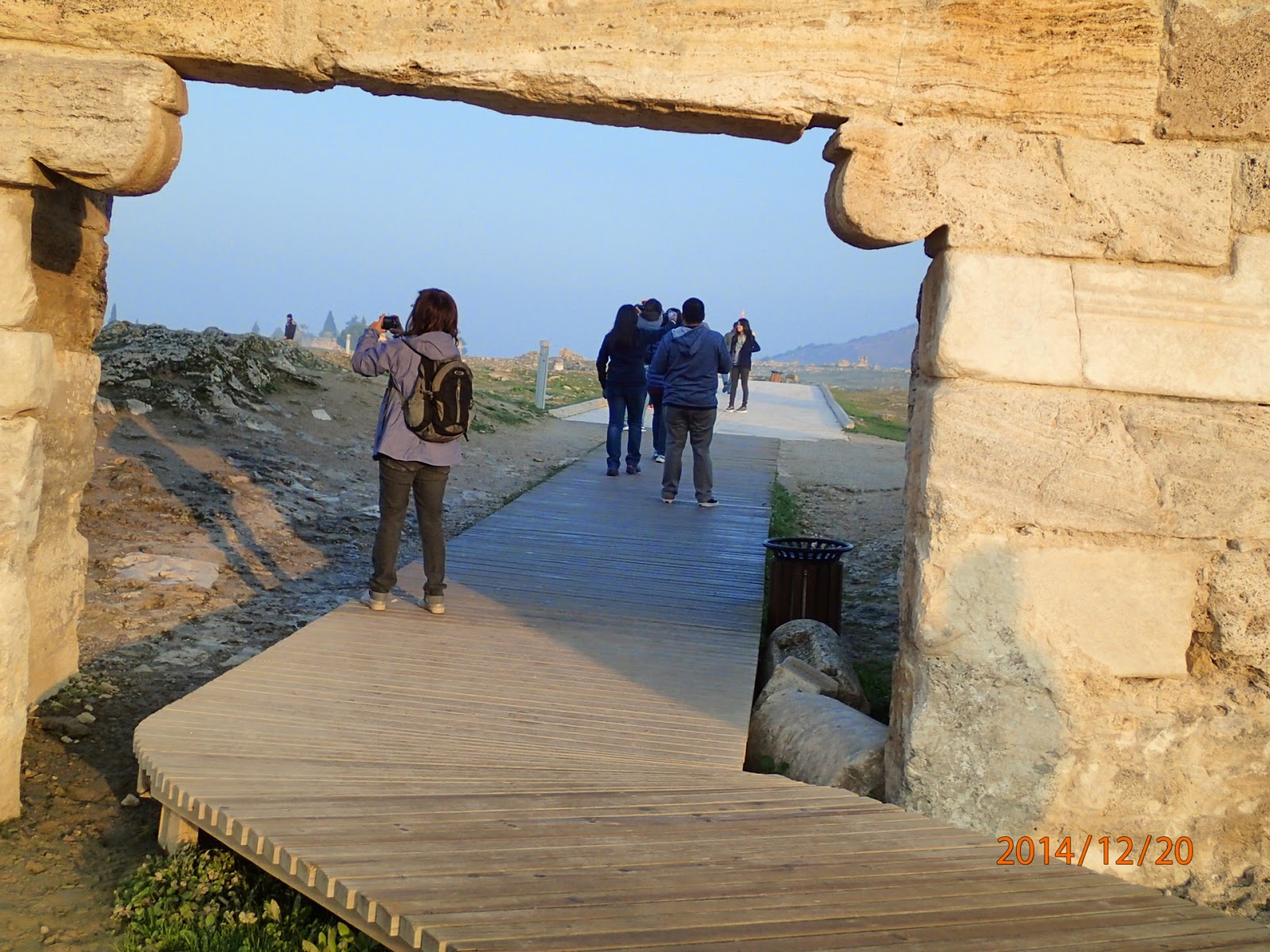
At the entrance of the UNESCO World Heritage Site of Pamukkale.
Pamukkale, meaning "cotton castle" in Turkish, is a natural site. The city contains hot springs and travertines, terraces of carbonate minerals left by the flowing water. It is located in Turkey's Inner Aegean region, in the River Menderes valley, which has a temperate climate for most of the year.

Tourism is and has been a major industry. People have bathed in its pools for thousands of years. As recently as the mid-20th century, hotels were built over the ruins of Hierapolis, causing considerable damage. An approach road was built from the valley over the terraces, and motor bikes were allowed to go up and down the slopes.
Deriving from springs in a cliff almost 200 m high overlooking the plain, calcite-laden waters have created at Pamukkale (Cotton Palace) an unreal landscape, made up of mineral forests, petrified waterfalls and a series of terraced basins. At the end of the 2nd century B.C. the dynasty of the Attalids, the kings of Pergamon, established the thermal spa of Hierapolis. The ruins of the baths, temples and other Greek monuments can be seen at the site.
Wearing shoes in the water is prohibited to protect the deposits.
The pools are created from spring water rising from the ground at a point almost three hundred meters from the actual pools, the water emerges warm, around 35 degrees and is full of calcium. As it emerges and flows down the hills the calcium is deposited and slowly builds up creating the snow white terraces that hold small pools of light blue water.
Antique Pool is a modern spa complex with a thermal pool that is open to the public. The pool is surrounded by lush greenery and in it are marble columns, capitals and plinths that are believed to have fallen from the nearby Temple of Apollo during an earthquake, making this a sacred pool. Mineral-rich fresh water is constantly pumped in and the water felt warm to touch. Cleopatra is said to have swum in an earlier version of a pool here, but whether she did or not, I must say that this pool looks idyllic and inviting, but unfortunately we didn’t come prepared for a swim.
 It was during the Roman period that the city’s reputation as a health centre boomed. The hot springs, with its mineral rich waters are said to be good for illnesses such as skin diseases, circulation problems, rheumatism, heart diseases and many other ailments and people flocked here to find relief for their diseases. At the height of this health tourism, there were more than fifteen baths in Hierapolis.
The ancient Greco-Roman and Byzantine city of Hierapolis was built on top of the white "castle" which is in total about 2,700 metres (8,860 ft) long, 600 m (1,970 ft) wide and 160 m (525 ft) high. It can be seen from the hills on the opposite side of the valley in the town of Denizli, 20 km away.

Dondurma (literally Turkish for "freezing") is the name given to ice cream in Turkey. Dondurma typically includes the ingredients milk, sugar, salep, and mastic. It is believed to originate from the city and region of Maraş and hence also known as Maraş Ice Cream.

Wednesday, January 07, 2015

Turkey - Ephesus the Great Greek Ancient City - Day 3

As usual we have to wake up early in the morning assisted by a morning call, by the way we were staying at Marina Hotel, Kusadasi old but clean and nice.
What a beautiful view from our balcony overlooking the Aegean Sea. I hope to come back here to stay a bit longer to explore more on Kusadasi.
The journey from Kusadasi to Ephesus site is about 20km before reaching Ephesus, we visited a leather factory and xiang had a chance to do a cat walk with some models. After that it was time to enjoy the great ancient Greek City.
Nike is seen with wings in most statues and paintings, one of the most famous being the Winged Victory of Samothrace. Most other winged deities in the Greek pantheon had shed their wings by Classical times. Nike is the goddess of strength, speed, and victory. Nike was a very close acquaintance of Athena, and is thought to have stood in Athena's outstretched hand in the statue of Athena located in the Parthenon. Nike is one of the most commonly portrayed figures on Greek coins.Now we know, Nike, Inc., an American multinational corporation takes its name from Nike, the Greek goddess of victory.
It was built in the 10th century BC on the site of the former Arzawan capital by Attic and Ionian Greek colonists. During the Classical Greek era it was one of the twelve cities of the Ionian League. The city flourished after it came under the control of the Roman Republic in 129 BC. According to estimates Ephesus had a population of 33,600 to 56,000 people in the Roman period, making it the third largest city of Roman Asia Minor after Sardis and Alexandria Troas.
The city was famed for the Temple of Artemis (completed around 550 BC), one of the Seven Wonders of the Ancient World. In 268 AD, the Temple was destroyed or damaged in a raid by the Goths. It may have been rebuilt or repaired but this is uncertain, as its later history is not clear. EmperorConstantine I rebuilt much of the city and erected new public baths. Following the Edict of Thessalonica from emperor Theodosius I, what remained of the temple was destroyed in 401 AD by a mob led by St. John Chrysostom. The town was partially destroyed by an earthquake in 614 AD. The city's importance as a commercial center declined as the harbor was slowly silted up by the Cayster River.
Ephesus had advanced public works, including municipal toilets with more than a dozen marble seats in place that can still be seen to this day.
A series of 36 holes designed to handle your business stretch across three long benches, and a trough where relatively clean water would be flowing lies near your feet. Toilet paper being a fairly modern convenience in this part of the world, the trough was used to dampen your sponge on a stick (known as a "tersorium") for personal cleansing, and then to "rinse off" said sponge.
The waste channels hidden within the murky innards of the city were deep for the standards of the times, between 2 and 4 meters depending on location. It is said that if things were chilly, the high-rolling Ephesians would send their slaves down to warm the seats for them in anticipation of their arrival.
Temple of Hadrian is one of the best preserved and most beautiful structures on Curetes Street. It was built before 138 A.D by P.Quintilius and was dedicated to the Emperor Hadrian, who came to visit the city from Athens in 128 A.D The facade of the temple has four Corinthian columns supporting a curved arch, in the middle of which contains a relief of Tyche, goddess of victory. The side columns are square. The pedestal with inscriptions in front of the temple, are the bases for the statues of the emperors between 293-305 CE, Diocletian, Maximian, Constantius I, and Galerius.
The library of Celsus is an ancient Roman building. It was built in honour of the Roman Senator Tiberius Julius Celsus Polemaeanus (completed in 135 AD) by Celsus' son, Gaius Julius Aquila (consul, 110 AD). Celsus had been consul in 92 AD, governor of Asia in 115 AD, and a wealthy and popular local citizen. He was a native of nearby Sardis and amongst the earliest men of purely Greek origin to become a consul in the Roman Empire and is honoured both as a Greek and a Roman on the library itself. Celsus paid for the construction of the library with his own personal wealth.
The Thinker was seen at Ephesus.
Ephesus was one of the seven churches of Asia that are cited in the Book of Revelation. The Gospel of John may have been written here. The city was the site of several 5th century Christian Councils (see Council of Ephesus). It is also the site of a large gladiators' graveyard. The ruins of Ephesus are a favourite international and local tourist attraction.
This is the most magnificent structure in Ephesus ancient city. The Great Theatre is located on the slope of Panayir Hill, opposite the Harbor Street, and easily seen when entering from the south entrance to Ephesus. It was first constructed in the Hellenistic Period, in the third century BC, during the Roman Period, it was enlarged and formed its current style that is seen today.
It is the largest in Anatolia and has the capacity of 25,000 seats. There are three sections of seats. In the lower section, Marble pieces, used for restoration, and the Emperor's Box were found. The seats with backs ,made of marble, were reserved for important people. The audience entered from the upper cavea.
The theatre was used not only for concerts and plays, but also for religious, political and philosophical discussions and for gladiator and animal fights.
One of the street scene at Ephesus.
That was it our visit to Ephesus and slowly my knowledge of History is building up as compared to my school days which I actually dislike Roman History...
Lunch was at a small theme park called Cittantica Ephesus Park and the place we dined was known as Artemission. Looks like this place is relatively new with shops for visitors to indulge.
The food was nice and interesting as compared most of the places we ate.

This is the entrance of Artemission which is actually a multipurpose hall.